
In the present era, the majority of lifestyle disorders are caused by unhealthy lifestyle choices such as poor eating habits, lack of physical activity, and mental stress. Ayurveda emphasizes the principle of “Swasthyasya Swasthya Rakshanam, Aturasya Vikara Prashamanam Cha,” which means maintaining the health of healthy individuals and alleviating diseases in the diseased.
According to Ayurveda, Ahara (diet), Nidra (sleep), and Brahmacharya (regulated lifestyle/celibacy) are considered the Trayopasthambha (three pillars of life), which play a crucial role in maintaining a healthy life. Charaka defines Ahara as an important factor responsible for both health and disease. Wholesome food leads to happiness and well-being, whereas unwholesome food becomes the cause of misery and illness.
Ahara provides satisfaction, immediate strength, nourishment to the body, longevity, radiance, enthusiasm, memory, courage, and improved digestive capacity.
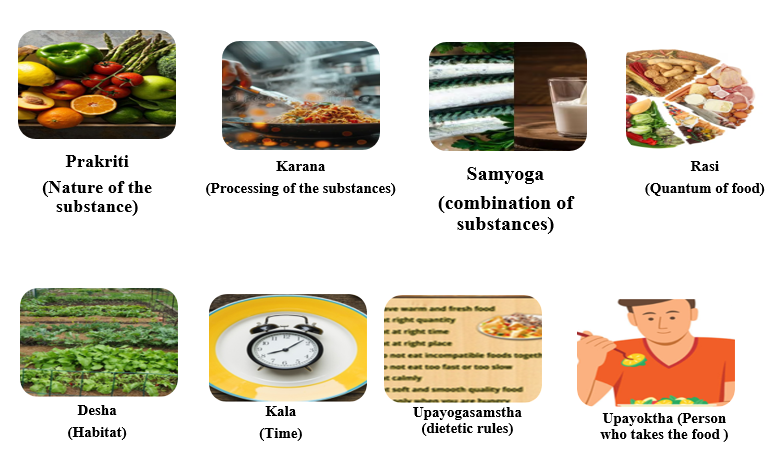
In Ayurveda, there are eight interrelated principles that govern dietary practices. These principles help in maintaining proper digestion, metabolism, and overall health. They are:
- Prakriti (Nature of food)
- Karana (Processing of food)
- Samyoga (Combination of food substances)
- Rashi (Quantity of food)
- Desha (Habitat or place)
- Kala (Time)
- Upayoga Samstha (Rules for food intake)
- Upayokta (Individual characteristics of the consumer)
1. Prakriti (Nature of Food)
Prakriti indicates the natural qualities of a food substance, such as whether it is heavy (guru) or light (laghu) for digestion. These qualities influence digestibility and their effect on the body.
For example, Masha (black gram) is considered heavy for digestion, whereas Mudga (green gram) is considered light and easily digestible.
Knowing the nature of food will help in choosing the food according to our digestion capacity and there by it is beneficial for our health and not causing any adverse effect.
2. Karana (Processing of Food)
Karana refers to the processing methods that modify the inherent properties of food substances. Processing can transform the qualities of food and thereby alter its effects on the body.
Transformation of attributes occurs through methods such as dilution, heating, cleansing, churning, storing, flavouring, preservation, and the type of container used.
Example- manthana-churning- dadhi(curds) is said to be heavy for digestion, but while churning process, it gets converted into takra(buterr milk). Which is laghu(light) for digestion.
Agni sannikarsha- boiling, roasting, steaming, frying are the examples for again sannikarsha(heat-based processing). Heating alters various properties of the substance.
Eg: boling the water- i.e – ushna jala- does enhances the digestion and metabolism, clears the body channels, which is opposite to qualities of normal water or cold water.
Cooking methods affect the taste, texture, digestibility and nutritional value of food. However, excessive heat and overcooking may destroy important nutrients, especially vitamins. Healthy cooking practices help preserve nutritents, improve safety and enhance the overall quality of food.
3. Samyoga (Combination)
Samyoga refers to the combination of two or more food substances. Such combinations may produce effects and properties that are not present in the individual substances alone. Some combinations are beneficial, while others may be harmful to health.
For example, honey and ghee are individually beneficial for health, but when mixed in equal quantities, they are considered harmful according to Ayurveda. Similarly, fish and milk should not be consumed together.
Knowledge of the proper as well as improper combinations is essential, in order to prevent any of the
disease resulting out of the later.
4. Rashi (Quantity)
The quantity of food intake plays a vital role in digestion and maintenance of health.
- Sarvagraha refers to the total quantity of the meal as a whole.
- Parigraha refers to the quantity of each individual component of the meal.
Ayurveda advises consuming food according to one’s digestive capacity. It recommends filling one-third of the stomach with solid food, one-third with liquids, and leaving one-third empty to facilitate proper digestion.
5. Desha (Habitat)
Desha refers to the geographical region or habitat where food substances are cultivated. Ayurveda emphasizes the importance of locally grown and seasonal foods, as they are believed to be in harmony with the body’s natural rhythms and environmental conditions.
6. Kala (Time)
Kala refers to time and is considered in two aspects:
- Nityaga Kala – regular timing of food intake during day and night, including dietary changes according to seasons in healthy individuals.
- Avasthika Kala – timing related to different stages of disease and different stages of life.
Proper timing of food intake is considered essential for maintaining health and preventing disease.
7. Upayoga Samstha (Dietetic Rules)
Upayoga Samstha refers to the rules and regulations for proper food intake. These rules depend upon Jeerna Ahara Lakshana (signs of proper digestion), such as:
- clear belching,
- enthusiasm,
- proper evacuation of natural urges,
- lightness of the body,
- appearance of hunger, and
- manifestation of thirst.
The rules for taking food include:
- Food should be warm and freshly prepared.
- Food should be unctuous.
- Food should be consumed in proper quantity.
- Meals should be taken only after digestion of the previous meal.
- Food with incompatible substances should be avoided.
- Food should be consumed in a suitable environment.
- Food should neither be eaten too quickly nor too slowly.
- Food should be consumed with concentration and mindfulness.
8. Upayokta (Individual Who Consumes Food)
Upayokta refers to the individual who consumes food. The person himself is mainly responsible for maintaining health through proper and habitual intake of wholesome food. The suitability of diet depends upon individual factors such as digestive capacity, habits, age, and health condition.
Conclusion
Ashta Ahara Vishesha Ayatana provides a comprehensive framework for healthy dietary practices in Ayurveda. These eight principles emphasize that proper nutrition depends not only on the type of food consumed, but also on its processing, combination, quantity, timing, place, method of intake, and the individual consuming it. By following these Ayurvedic dietary guidelines, one can maintain proper digestion, balance of doshas, and overall physical and mental well-being. In the present era of increasing lifestyle disorders, the concept of Ashta Ahara Vishesha Ayatana offers a holistic approach for promoting health, preventing diseases, and achieving a healthy lifestyle.